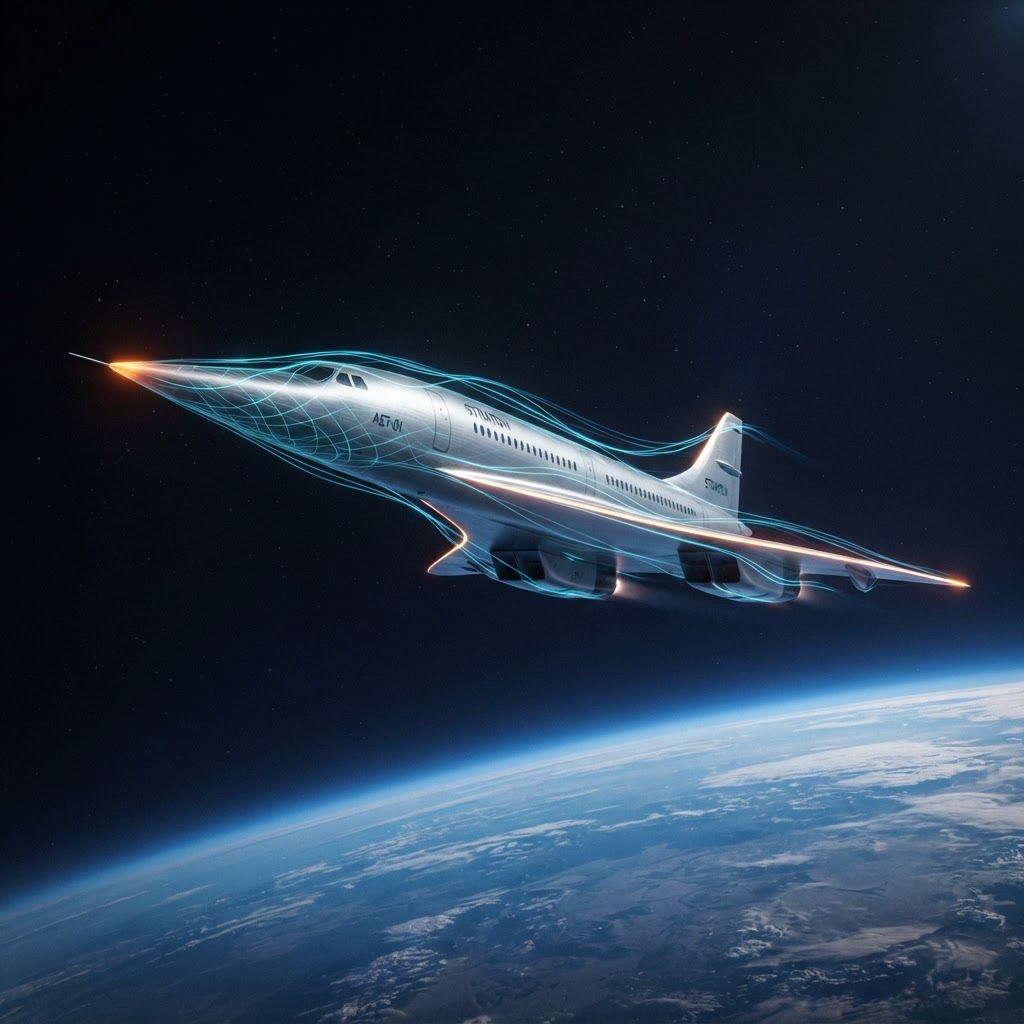
The sky just reopened. Weave it.
The same plasma-orchestrating physics that reinvents spacecraft reentry now adapts for sustained supersonic and hypersonic flight — actively shaping the airflow to cut drag, tame heat, and soften the boom. Aviation works with the flow, not against it.
- 2026
- the US 52-year overland supersonic ban is lifted
- Mach 3+
- sustainable cruise is the design target, not a stunt
- One platform
- shared core tech with the space flagship
Why fast flight stayed hard
Supersonic and hypersonic flight have never lacked ambition — they lacked a way to handle four brutal, coupled physics problems at once, for hours at a time, economically. Every one of them traces back to how the vehicle fights the air instead of working with it.
Thermal loads
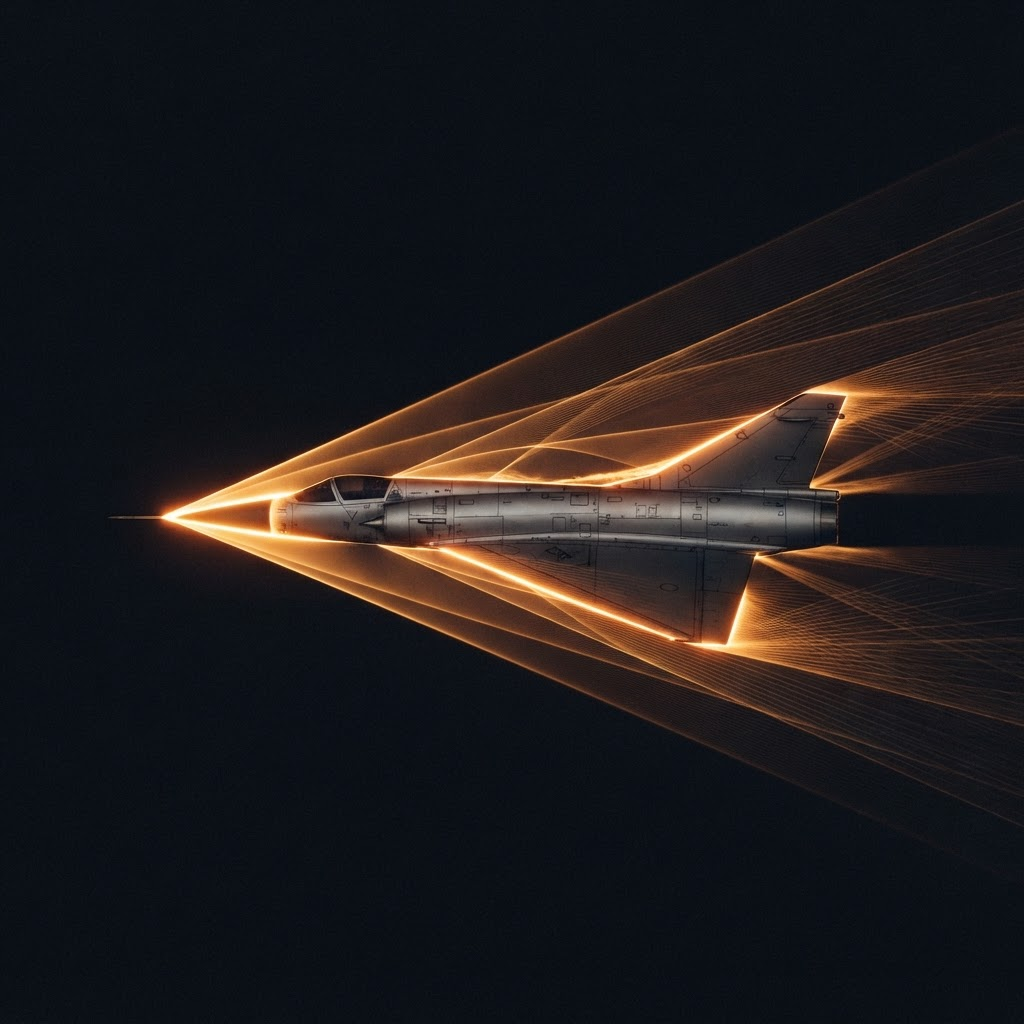
Above Mach 2, aerodynamic heating turns leading edges and skin into a materials problem. Sustained Mach 3+ cruise bakes an airframe for hours, not minutes — a fundamentally harsher duty cycle than a brief spacecraft entry.
Wave drag
Shock waves are drag made visible. The energy poured into forming and dragging those shocks dominates the fuel bill and caps the practical top speed of any conventional supersonic design.
Sonic boom
The overpressure signature is what grounded civil supersonic flight for half a century. Reopening the skies means the boom has to be shaped and softened, not merely tolerated.
Material limits
Passive heat-resistant structures are heavy, expensive, and maintenance-hungry. They add dead mass exactly where every kilogram costs range, payload, and economics.
The same physics, tuned for cruise
AeroWeave is not a new invention bolted onto an aircraft — it is the Symbiotic Flow Weaver platform re-tuned from a violent few-minute reentry to a steady, hours-long high-speed cruise. Five adaptations turn the space shield into an aviation flow-control system.
Lower-power magnetics
Reentry needs a brute-force magnetopause for a few violent minutes. Cruise is gentler and steady, so AeroWeave trades peak field strength for efficient, continuous operation — modest coils sustained indefinitely rather than a short, intense pulse.
Plasma flow control
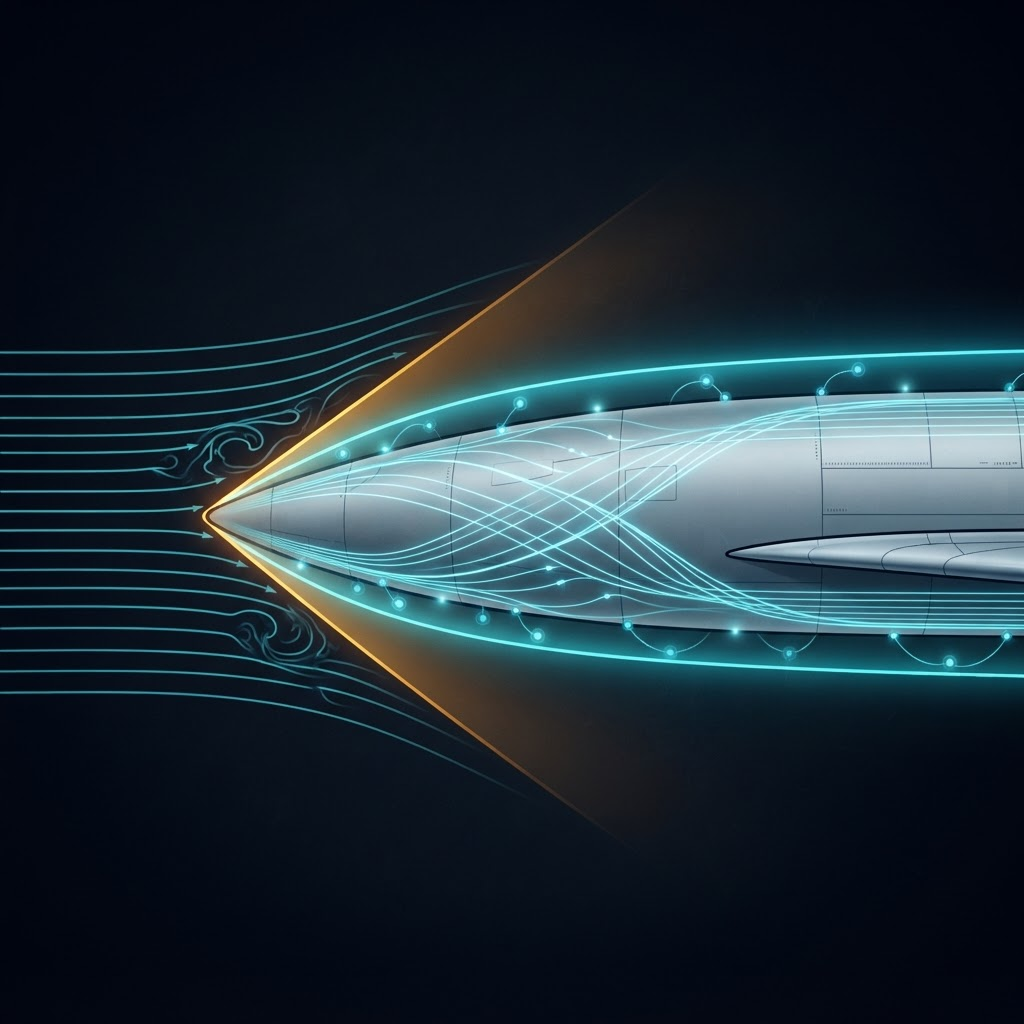
A weakly-ionized boundary layer, shaped by distributed fields, nudges shock waves outward and keeps the flow attached. Softening and spreading those shocks directly attacks wave drag and lifts the practical Mach ceiling.
Boom mitigation
By actively re-shaping the pressure field around the airframe, AeroWeave smears the sharp N-wave signature into a gentler rise — turning a startling boom into a soft thump, the enabling trick for overland routes.
Energy harvesting in cruise
The same magnetohydrodynamic coupling that steers the flow can tap energy from it. Over a multi-hour cruise, that harvested power offsets the system’s own draw — the shield helps pay for itself.
AI orchestration
An onboard model reads the flow field in real time and continuously tunes field strength, ionization, and harvesting across the airframe — holding the optimal drag, thermal, and acoustic state through changing altitude and speed.
These are directional engineering targets, not certified performance claims. The point is that each mechanism is a tractable extension of physics already being validated for the space application — not a new miracle that has to be invented from scratch.
Why it changes the economics
Speed alone never sold supersonic flight — economics did it in. AeroWeave is designed to move the numbers that actually decide adoption: mass, drag, fuel, noise, and reuse.
Lighter airframes, better efficiency
Active flow control replaces much of the heavy passive thermal structure. Less dead mass means more range and payload from the same fuel — the compounding advantage that decides whether a route closes economically.
- Reduced structural mass
- More payload per flight
- Improved lift-to-drag
Higher sustainable Mach
By attacking wave drag and heating at their source, AeroWeave pushes the practical cruise speed higher and holds it there for hours — turning peak numbers into sustainable, repeatable operations.
- Higher cruise ceiling
- Sustained, not momentary
- Stable across the envelope
Lower cost & footprint
Less drag and self-harvested power mean less fuel burned per seat-mile, while shaped booms unlock efficient overland routes. Better economics and a lighter environmental signature reinforce each other.
- Lower fuel burn per seat-mile
- Overland routes viable
- Reduced emissions intensity
Dual-use synergy
Every dollar and lesson invested in AeroWeave strengthens the space flagship, and vice versa. One core platform, two markets, shared R&D, and a compounding technology moat.
- Shared core IP
- Cross-funded R&D
- Faster joint iteration
A 52-year ban just ended
In 2026 the United States moved to lift its decades-old overland supersonic flight ban, shifting the rule from a hard speed limit to a noise standard. That single change reopens a market that has been frozen since Concorde — and rewards whoever can fly fast and quiet.

Commercial SST / HST
A new generation of supersonic and hypersonic transports needs an edge that closes the business case. AeroWeave offers the drag, thermal, and noise margins that turn prototypes into profitable fleets.
Point-to-point travel
Shaped booms make overland corridors legal, and higher sustainable Mach collapses intercontinental times. The prize is any-city-to-any-city in a few hours — the market supersonic always promised but never delivered.
Military & special mission
Sustained high-Mach cruise, managed thermal signatures, and onboard power generation are decisive for reconnaissance, rapid response, and next-generation platforms.
The regulatory door is open, credible builders are already flying demonstrators, and the deciding variable is enabling technology. AeroWeave is aimed squarely at that gap.
One platform, many flight regimes
AeroWeave is not a pivot away from the space flagship — it is proof of how deep the core technology runs. The same four building blocks that protect a spacecraft during reentry are simply re-tuned for the atmosphere. Master the platform once; deploy it across every high-speed flight regime.
| CORE TECHNOLOGY | Space — Reentry (SFW) | Aviation — Cruise (AeroWeave) |
|---|---|---|
| Metamaterial surfaces | Radiate and reroute reentry heat | Shape shocks and manage cruise heating |
| MHD flow control | Stand plasma off the hull | Bend shocks, cut drag, soften booms |
| AI orchestration | Tune the shield thousands of times/sec | Hold optimal drag & acoustic state |
| Energy harvesting | Draw power from the entry plasma | Offset system draw across cruise |
Let's reopen the skies together
AeroWeave is an open invitation to the people building the supersonic era. If you design airframes, set flight policy, run high-speed research, or fund hard technology — we want to pressure-test this with you and put it on real wings.