The honest numbers, out in the open.
An idea earns credibility not by how bold it sounds, but by how willingly it shows its work. Here is the physics behind the Symbiotic Flow Weaver, the mass, power, thermal, and cost budgets as we currently estimate them, an unflinching comparison against today's ceramic tiles, and the honest risks. We publish our uncertainty on purpose.
A note on honesty. The Symbiotic Flow Weaver is a Pinnacle Empire innovation built on established, published physics. Every number here is a directional estimate meant to start a rigorous conversation, not a flight specification. Where we are unsure, we say so.
Established science, assembled deliberately
The individual effects are established science. The innovation is Pinnacle Empire's: combining well-understood effects into a single active thermal-protection system. Here is the vocabulary, in plain terms.
- Magnetohydrodynamics (MHD)
- The behavior of electrically conducting fluids — like reentry plasma — inside magnetic fields. It is the single governing framework for both deflecting the flow and harvesting power from it.
- Lorentz force
- The force on charged particles moving through a magnetic field. Applied across an ionized boundary layer, it is the physical mechanism that pushes plasma away from the hull.
- Artificial magnetopause
- A vehicle-scale analogue of the boundary where a planet’s magnetic field deflects the solar wind — generated here by onboard HTS coils to stand the plasma off the ship.
- Plasma weave
- Closed-loop modulation of the field so the deflected flow is smoothed and steered around the hull, reducing localized hot spots rather than merely blunting the average load.
- Plasma seeding
- Introducing trace, easily-ionized species to raise conductivity, so magnetic control and power extraction become practical at lower — and therefore lighter — field strengths.
- MHD energy harvesting
- Extracting electrical power directly from the conducting flow as it moves through the field, turning part of reentry’s wasted energy into usable onboard power.

Six budgets, stated with our confidence in each
A credible system accounts for what it costs, not only what it saves. We label our confidence honestly — and the lowest-confidence items are exactly where we most want scrutiny.
Mass
Neutral-to-favorable (target)
Low confidence
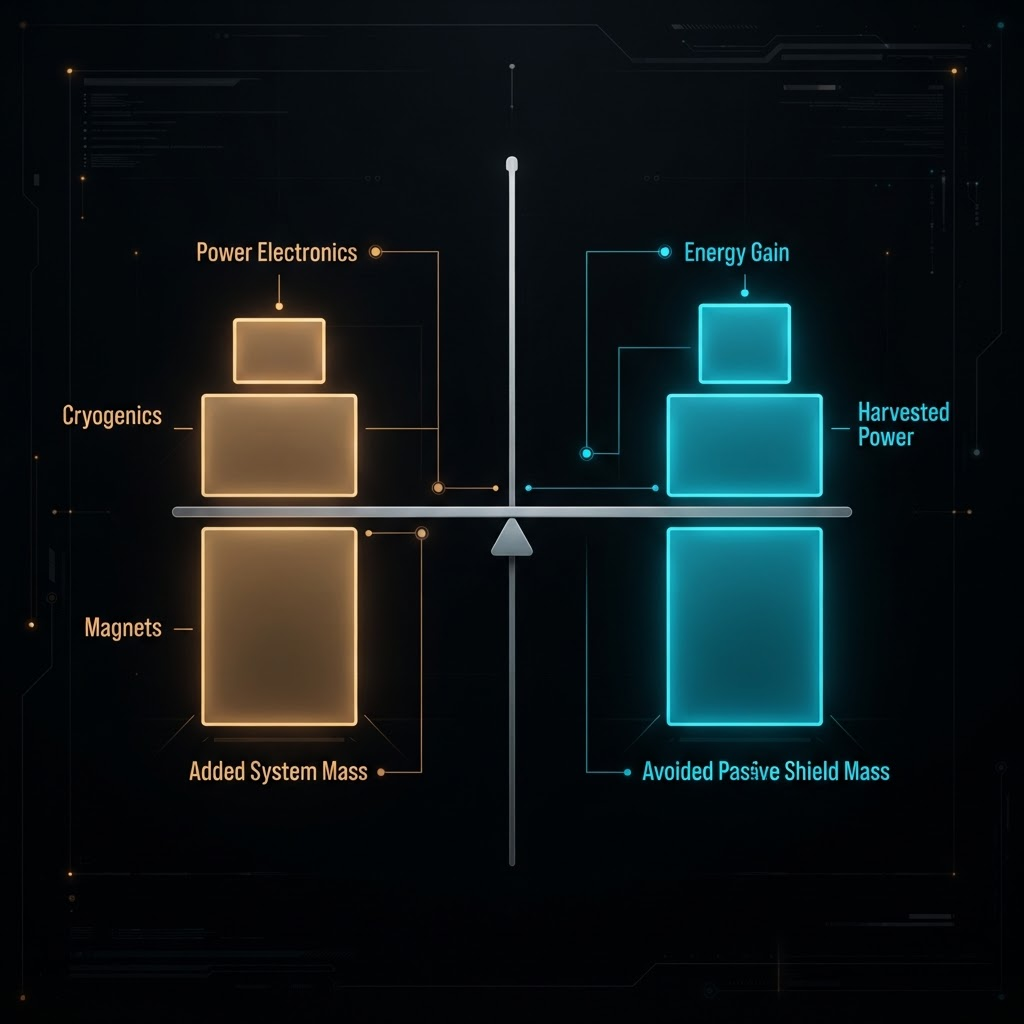
Added: HTS coils, cryogenics, power electronics, seeding. Avoided: worst-case passive-shield margin. The entire thesis rests on the avoided mass exceeding the added mass — this is the trade to close first.
Power / Electrical
Hundreds of kW – low MW, transient
Low confidence
Field maintenance and control demand transient peak-heating power. MHD harvesting is intended to offset a meaningful fraction — the goal of net-positive during peak entry is our lowest-confidence claim.
Thermal
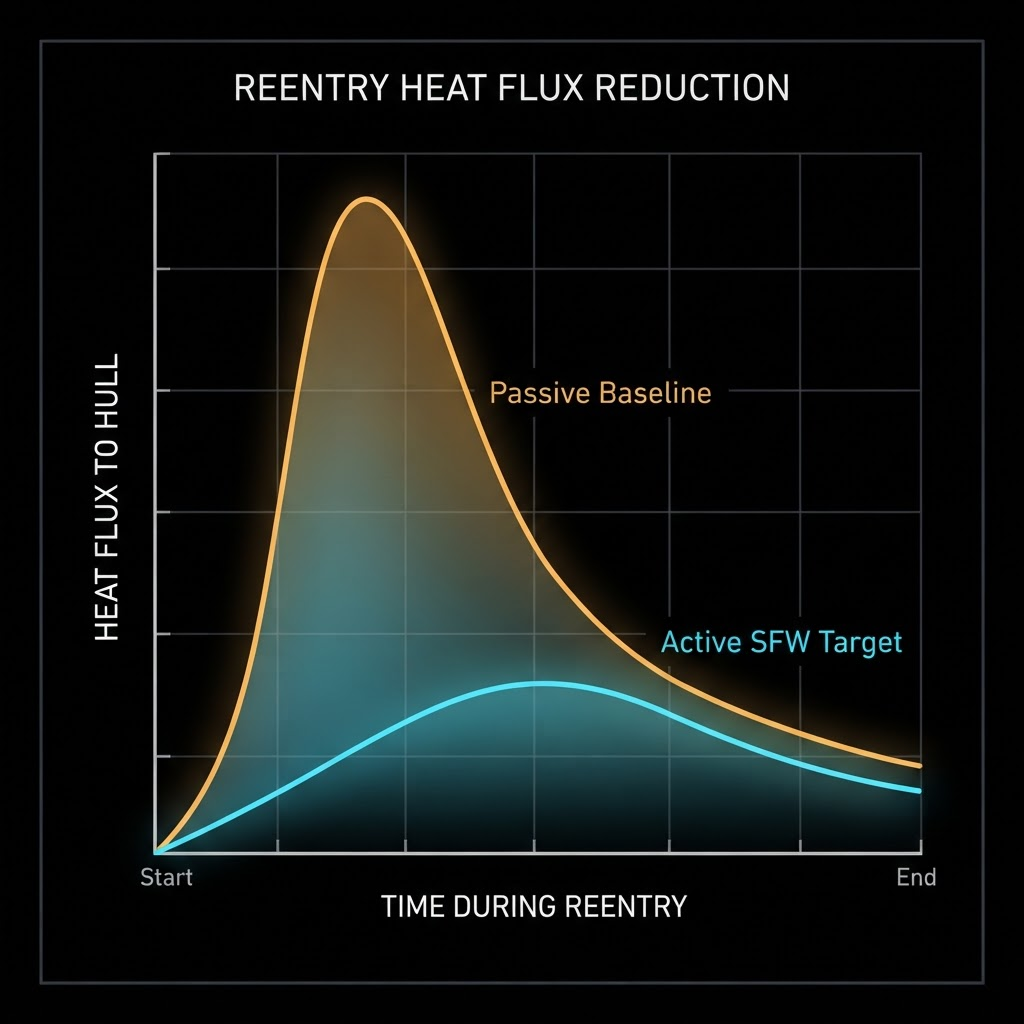
30–60% peak-flux reduction (target)
Low–Medium
Standoff and weave cut the convective load; the metamaterial skin manages residual radiation. Running cryogenic magnets near a multi-thousand-Kelvin boundary is a genuinely hard isolation problem.
Structural
New design driver
Medium
Magnetic forces react against the airframe and must be distributed without local overstress. This is a first-order structural consideration, addressed with early finite-element analysis.
Reliability
Graceful degradation required
Medium
Active systems add failure modes passive shields lack. The vehicle must survive a field-system fault on residual passive protection. SFW is designed to augment first, replace second.
Cost
Higher unit, lower lifecycle
Medium
More per-unit complexity, offset in the thesis by radically lower refurbishment cost and higher flight cadence — the same economic logic as the shift from expendable to reusable.
Against today’s ceramic tiles
We are explicit about this: tiles win today on maturity and simplicity. SFW’s claim is about the ceiling of what’s possible, not the floor of what already works.
| Dimension | Ceramic tiles (passive) | Symbiotic Flow Weaver (active) |
|---|---|---|
| Operating principle | Absorb & re-radiate heat | Deflect, weave & harvest |
| Peak heat reaching hull | Full | Reduced (target 30–60%) |
| Energy of reentry | Wasted | Partially harvested |
| Dominant failure mode | Point-failure sensitive | Graceful degradation (goal) |
| Turnaround | Inspect every tile | Inspect subsystems |
| Comms blackout | Present | Reducible |
| Added active mass | None | Significant (magnets, cryo) |
| Maturity (TRL) | 9 — flight-proven | 2–3 — concept/analytical |
Quantitative estimates (directional)
Order-of-magnitude figures offered to be challenged, not measured flight data. The confidence column is the most important one.
| Parameter | Baseline | SFW target | Confidence |
|---|---|---|---|
| Peak stagnation heat flux to hull | 100% (ref) | 30–60% reduction | Low–Med |
| TPS-related dry mass (system) | 100% (ref) | 10–30% reduction | Low |
| Peak electrical power | ~0 | Hundreds kW – low MW | Low |
| Power harvested at peak | 0 | Net-positive (target) | Very low |
| Turnaround inspection labor | 100% (ref) | Major reduction | Medium |
| Comms blackout window | Full | Partial-to-eliminated | Low–Med |
What could break this — and what we do about it
A proposal that hides its risks is not credible. The highest-severity risks are the ones we lead with, because they define the experiments that matter most.
- High
The power / harvest trade does not close
Mitigation. Validate MHD harvesting in an arc-jet before committing to the architecture. If it cannot be net-positive, the concept scales back to flux reduction only.
- High
Magnet + cryogenic mass exceeds savings
Mitigation. Adopt zonally — deploy only where heating is worst — so the system never carries mass it cannot justify.
- High
Cryogenics fail near the hot boundary
Mitigation. Dedicated thermal isolation plus a passive fallback layer beneath the active system.
- Medium
Structural loads from the field
Mitigation. Distribute reaction loads into the airframe; drive the design with early finite-element analysis rather than treating it as an afterthought.
- Medium
Active-system reliability
Mitigation. Graceful degradation by design; augment-not-replace rollout so a fault is survivable, never catastrophic.
- Low–Med
Seeding logistics / contamination
Mitigation. Minimal trace seeding with bounded, well-characterized consumables.
From analysis to routine reflight
Technology Readiness Levels keep us honest about where we actually are: today this is a concept backed by analysis. Each step must pay for itself in data before the next begins — patch, then zonal, then full shield.

- TRL 2–3Now
Analytical synthesis, first-principles budgets, open publication.
- TRL 3–4Next
Bench MHD deflection & harvesting in plasma wind tunnels and arc-jets; HTS coil characterization.
- TRL 4–5
Integrated subscale article combining coil, seeding, and harvesting under representative heat flux.
- TRL 5–6
Flight-representative zonal patch on a suborbital or secondary test surface.
- TRL 6–7
Zonal augmentation on an operational reusable vehicle.
- TRL 7–9
Full-shield qualification and routine reflight.
Standing on real, published work
We did not invent this physics — we engineered an original system around it. These are the real research directions the Symbiotic Flow Weaver builds upon. Full citations are available on request.
MEESST
EU-funded work on superconducting magnetohydrodynamic heat-shield concepts — magnetic flow control for atmospheric reentry.
Plasma wind-tunnel & arc-jet studies
Ground facilities that reproduce reentry heat flux, the proving ground where this proposal will live or die.
HTS magnet advances (2025–26)
Compact high-temperature superconducting coils maturing rapidly in fusion and propulsion research — our critical enabling path.
Seeded MHD power extraction
A long-studied technique for raising plasma conductivity to make practical energy harvesting possible.
MHD aerobraking & flow-control literature
Decades of analytical and experimental groundwork on magnetically influencing hypersonic flows.
Read the full technical synthesis
Executive summary, detailed physics, quantitative budgets, the AeroWeave aviation adaptation, the development roadmap, and an open invitation to collaborate — assembled into one document, offered for your scrutiny.
A Pinnacle Empire innovation, part of the Pinnacle Ecosystem. Shared in service of humanity.